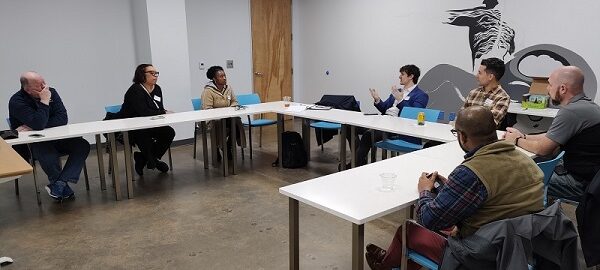
The Special Interest Group (SIG) event is participant-driven — we will have open discussion around topics related to the quality profession. We may have a theme but no formal speakers or agenda. Everyone is encouraged to participate in the discussion. So bring your questions and ideas to share with other participants.
This event is free and open to anyone who is interested in the quality profession. No ASQ membership is required. ASQ members will receive RU credits for participation.
We will meet at Frontier RTP (first floor) at 4:30pm or whenever you can join us. It will be during Frontier RTP’s weekly Out of Office event. It’s a great opportunity to connect with people in the triangle community. More information will be provided to the registered attendees before the event.
Registration will be available 3-4 weeks before the event.
For questions, please contact Fang Zhou at ASQRaleighSIG@gmail.com.
Pre-meeting Office Hour
If you have some questions and would like to have a one-on-one discussion or consultation with someone who has relavent knowledge and experience, you can simply stop by before the SIG meeting and talk to one of the ASQ Raleigh member volunteers who will be there 3:30 – 4:30 pm. No appointment or registration is required, and you are welcome to attend the group meeting to gain additional perspectives from other attendees. For more details, please visit our Consultation page.
The Special Interest Group (SIG) event is participant-driven — we will have open discussion around topics related to the quality profession. We may have a theme but no formal speakers or agenda. Everyone is encouraged to participate in the discussion. So bring your questions and ideas to share with other participants.
This event is free and open to anyone who is interested in the quality profession. No ASQ membership is required. ASQ members will receive RU credits for participation.
We will meet at Frontier RTP (first floor) at 4:30pm or whenever you can join us. It will be during Frontier RTP’s weekly Out of Office event. It’s a great opportunity to connect with people in the triangle community. More information will be provided to the registered attendees before the event.
Registration will be available 3-4 weeks before the event.
For questions, please contact Fang Zhou at ASQRaleighSIG@gmail.com.
Pre-meeting Office Hour
If you have some questions and would like to have a one-on-one discussion or consultation with someone who has relavent knowledge and experience, you can simply stop by before the SIG meeting and talk to one of the ASQ Raleigh member volunteers who will be there 3:30 – 4:30 pm. No appointment or registration is required, and you are welcome to attend the group meeting to gain additional perspectives from other attendees. For more details, please visit our Consultation page.
The Special Interest Group (SIG) event is participant-driven — we will have open discussion around topics related to the quality profession. We may have a theme but no formal speakers or agenda. Everyone is encouraged to participate in the discussion. So bring your questions and ideas to share with other participants.
This event is free and open to anyone who is interested in the quality profession. No ASQ membership is required. ASQ members will receive RU credits for participation.
We will meet at Frontier RTP (first floor) at 4:30pm or whenever you can join us. It will be during Frontier RTP’s weekly Out of Office event. It’s a great opportunity to connect with people in the triangle community. More information will be provided to the registered attendees before the event.
Registration will be available 3-4 weeks before the event.
For questions, please contact Fang Zhou at ASQRaleighSIG@gmail.com.
Pre-meeting Office Hour
If you have some questions and would like to have a one-on-one discussion or consultation with someone who has relavent knowledge and experience, you can simply stop by before the SIG meeting and talk to one of the ASQ Raleigh member volunteers who will be there 3:30 – 4:30 pm. No appointment or registration is required, and you are welcome to attend the group meeting to gain additional perspectives from other attendees. For more details, please visit our Consultation page.
The Special Interest Group (SIG) event is participant-driven — we will have open discussion around topics related to the quality profession. We may have a theme but no formal speakers or agenda. Everyone is encouraged to participate in the discussion. So bring your questions and ideas to share with other participants.
This event is free and open to anyone who is interested in the quality profession. No ASQ membership is required. ASQ members will receive RU credits for participation.
We will meet at Frontier RTP (first floor) at 4:30pm or whenever you can join us. It will be during Frontier RTP’s weekly Out of Office event. It’s a great opportunity to connect with people in the triangle community. More information will be provided to the registered attendees before the event.
Registration will be available 3-4 weeks before the event.
For questions, please contact Fang Zhou at ASQRaleighSIG@gmail.com.
Pre-meeting Office Hour
If you have some questions and would like to have a one-on-one discussion or consultation with someone who has relavent knowledge and experience, you can simply stop by before the SIG meeting and talk to one of the ASQ Raleigh member volunteers who will be there 3:30 – 4:30 pm. No appointment or registration is required, and you are welcome to attend the group meeting to gain additional perspectives from other attendees. For more details, please visit our Consultation page.
The Special Interest Group (SIG) event is participant-driven — we will have open discussion around topics related to the quality profession. We may have a theme but no formal speakers or agenda. Everyone is encouraged to participate in the discussion. So bring your questions and ideas to share with other participants.
This event is free and open to anyone who is interested in the quality profession. No ASQ membership is required. ASQ members will receive RU credits for participation.
We will meet at Frontier RTP (first floor) at 4:30pm or whenever you can join us. It will be during Frontier RTP’s weekly Out of Office event. It’s a great opportunity to connect with people in the triangle community. More information will be provided to the registered attendees before the event.
Register here.
For questions, please contact Fang Zhou at ASQRaleighSIG@gmail.com.
Pre-meeting Office Hour
If you have some questions and would like to have a one-on-one discussion or consultation with someone who has relavent knowledge and experience, you can simply stop by before the SIG meeting and talk to one of the ASQ Raleigh member volunteers who will be there 3:30 – 4:30 pm. No appointment or registration is required, and you are welcome to attend the group meeting to gain additional perspectives from other attendees. For more details, please visit our Consultation page.
The Special Interest Group (SIG) event is participant-driven — we will have open discussion around topics related to the quality profession. We may have a theme but no formal speakers or agenda. Everyone is encouraged to participate in the discussion. So bring your questions and ideas to share with other participants.
This event is free and open to anyone who is interested in the quality profession. No ASQ membership is required. ASQ members will receive RU credits for participation.
We will meet at Frontier RTP (first floor) at 4:30pm or whenever you can join us. It will be during Frontier RTP’s weekly Out of Office event. It’s a great opportunity to connect with people in the triangle community. More information will be provided to the registered attendees before the event.
Register here.
For questions, please contact Fang Zhou at ASQRaleighSIG@gmail.com.
Pre-meeting Office Hour
If you have some questions and would like to have a one-on-one discussion or consultation with someone who has relavent knowledge and experience, you can simply stop by before the SIG meeting and talk to one of the ASQ Raleigh member volunteers who will be there 3:30 – 4:30 pm. No appointment or registration is required, and you are welcome to attend the group meeting to gain additional perspectives from other attendees. For more details, please visit our Consultation page.
The Special Interest Group (SIG) event is participant-driven — we will have open discussion around topics related to the quality profession. We may have a theme but no formal speakers or agenda. Everyone is encouraged to participate in the discussion. So bring your questions and ideas to share with other participants.
This event is free and open to anyone who is interested in the quality profession. No ASQ membership is required. ASQ members will receive RU credits for participation.
We will meet at Frontier RTP (first floor) at 4:30pm or whenever you can join us. It will be during Frontier RTP’s weekly Out of Office event. It’s a great opportunity to connect with people in the triangle community. More information will be provided to the registered attendees before the event.
For questions, please contact Fang Zhou at ASQRaleighSIG@gmail.com.
Register here.
Pre-meeting Office Hour
If you have some questions and would like to have a one-on-one discussion or consultation with someone who has relavent knowledge and experience, you can simply stop by before the SIG meeting and talk to one of the ASQ Raleigh member volunteers who will be there 3:30 – 4:30 pm. No appointment or registration is required, and you are welcome to attend the group meeting to gain additional perspectives from other attendees. For more details, please visit our Consultation page.
The Special Interest Group (SIG) event is participant-driven — we will have open discussion around topics related to the quality profession. We may have a theme but no formal speakers or agenda. Everyone is encouraged to participate in the discussion. So bring your questions and ideas to share with other participants.
This event is free and open to anyone who is interested in the quality profession. No ASQ membership is required. ASQ members will receive RU credits for participation.
We will meet at Frontier RTP (first floor) at 4:30pm or whenever you can join us. It will be during Frontier RTP’s weekly Out of Office event. It’s a great opportunity to connect with people in the triangle community. More information will be provided to the registered attendees before the event.
Register here.
The Special Interest Group (SIG) event is participant-driven — we will have open discussion around topics related to the quality profession. We may have a theme but no formal speakers or agenda. Everyone is encouraged to participate in the discussion. So bring your questions and ideas to share with other participants.
Theme of the month: Process Improvement with Artificial Intelligence
This event is free and open to anyone who is interested in the quality profession. No ASQ membership is required. ASQ members will receive RU credits for participation.
We will meet at Frontier RTP (first floor) at 4:30pm or whenever you can join us. It will be during Frontier RTP’s weekly Out of Office event. It’s a great opportunity to connect with people in the triangle community. More information will be provided to the registered attendees before the event.
Register here.
The last Special Interest Group (SIG) meeting of 2025 welcomed three first-timers, among the eight attendees. One of them was preparing for his ASQ Six Sigma Green Belt (GB) certification and was interested in joining ASQ.
One of the attendees was a leader of a service provider using artificial intelligence (AI) to help their pharmaceutical clients in the quality and compliance area. He shared with us some of the work they did to automate tasks, reduce errors, and improve consistency.
Unsurprisingly, the topic of AI triggered many questions and responses among attendees. For example
- Where do we see the most improvement when AI automates the tasks?
- How much do we improve the the process before implementing AI or automation?
- How do the AI models or tools integrate with the existing Quality Management Systems (QMS)?
- How do we address regulatory or compliance concerns related to AI implementation?
Another attendee shared their experience using AI to process large amounts of literature and documents that humans just could not handle. But with AI, human experts only have to review a select subset of documents or a summary of the information. It sounded like many organizations have started experimenting with AI to evaluate its effectiveness and potential issues.
One of the concerns was people’s ability to learn and adapt to new technology vs. the speed of technological advance.
- Who are responsible for keeping up with the change?
- How much do employees have to learn on their own vs. training provided by employers?
- How can the educational system, such as universities, prepare students for the future?
There was a general consensus among the participants that data integrity training provided by employers was insufficient and junior employees might not have the opportunity to build experience or critical thinking if AI was widely implemented.
The interest and discussion about AI will certainly continue in future meetings. So join us in 2026 at our monthly SIG meetings on the second Thursday at Frontier RTP.
Happy Holidays!